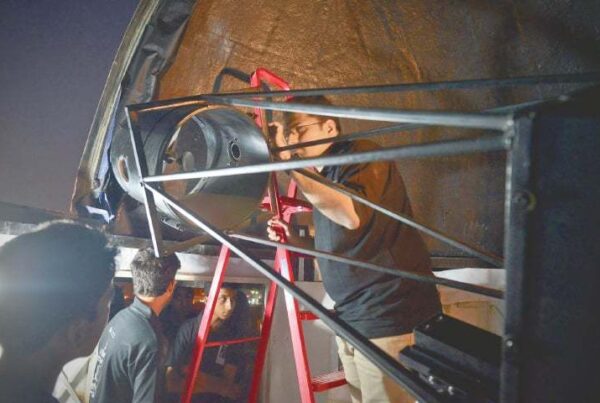
Ramiz Qureshi from Karachi was online. He told me that he was experiencing almost 100% transparent skies there. I thought to check out my portion of sky and therefore I went up the roof at around 12:30.
Tested the focus of my 10×50 binoculars at Jupiter, which was setting in South-West.
After Jupiter, I looked for Messier 31, The Andromeda Galaxy.
The time was 12:40 when I started looking for it. The sky was clear but there was much light pollution from neighboring homes.
My binoculars doesn’t give a wide-field view when I observe with spectacles on. So for observing I have to take out my spectacles. When I do so, I can’t see the stars and that makes a big problem for me.
Since I had no one to point at the location of objects with a laser pointer, I was at my own. It is said that “need is the mother of invention” therefore I used the water tank of my home as a guide.
I moved in such a position relative to the water tank that all the stars of Constellation Cassiopeia were hidden except the brightest star of it, Shedir (Alpha Cassiopeiae).

From Shedir, I took a way towards the left and a little down towards the Andromeda Galaxy. It was a small white cloudy thing in the sky. Though I couldn’t identify it as a galaxy, but it surely was distinguishable from the other stars in a sense that there was some cloudy appearance.

The Andromeda Galaxy is 2.5 Million Light Years away from the Earth. Do you know what does that mean? It means that light takes 2.5 Million Years to reach the Earth from M31. Compare it with the time of 1.2 second light takes to reach from the Moon to Earth.

After the Andromeda Galaxy, I tried to find NGC 752, an open cluster in the Constellation Andromeda but failed.
Seven Sisters were walking towards the West from the East, so I thought to gaze at them as they moved. They look really beautiful. Pleiades is an open cluster in Constellation Taurus. With naked eye, only 7 stars are visible but advanced observations have shown that the cluster contains about 1000 stars.

This cluster has been known since many ages. It has been found that Babylonian civilization knew about Pleiades cluster in 23rd century BC.
Recently a star disk called Nebra Sky Disk has been discovered which has been successfully dated back to 1600 BC. The disk has illustration of Pleiades on it.

After the Pleiades, I went for Double Cluster in Constellation Perseus at 12:54 AM.
For finding Double Cluster, I went straight up from the star Ruchbah (Delta Cassiopeiae) towards the star Mirphak (Alpha Persei). Between these two stars lies the Double Cluster NGC 884-NGC 869.

Afterwards, I thought to change the position and move at some other place for observing. This time I aimed for searching the South-Eastern region of the sky.
The brave hunter Orion was rising up with his criminal looking dog Canis Major (Big Dog)
Orion and Canis Major are very prominent constellations which are easily identifiable.

According to Greek mythology, Orion was a hunter whom Zeus elevated to heavens and placed among the stars.

Nearby Orion, the dogs of Orion are also present, namely Canis Major and Canis Minor. These are also constellations and have mythologies associated with them.
I tried to find NGC 2362 in the Constellation Canis Major. Since I was using Stellarium software for navigating through the sky, I easily located the site of it. But due to light pollution, I couldn’t notice any cluster there. For locating NGC 2362, I went left from Wezen (Delta Canis Majoris).

An asterism by the name of “The Boomerang” is also in the Constellation Canis Major. 6 stars form a pattern similar to that of a boomerang.
Now I once again turned towards the Constellation Cassiopeia and this time, my target was the Owl Cluster (NGC 457).

At 1:13, I observed the most famous, the most brilliant and the most favorite object for the astronomers of all ages, The Orion Nebula, Messier 42.