
In 2018, the Herald magazine assigned me the responsibility to report on electoral contests in eight districts of Sindh, namely Mirpurkhas, Tando Allahyar, Tando Muhammad Khan, Matiari, Dadu, Jamshoro, Hyderabad, and Sanghar.
Because the magazine had space constraints, only the excerpts from those reports were published in Herald’s July 2018 issue while the rest of it — approximately 5000 words — remained unpublished.
I have finally decided, in 2025, to put them all online in their original form because firstly, I worked hard for them and traveled far and wide in the intense June heat of Sindh so I think they should not remain unused; and secondly, I hope, someone some day may find them usable for some project that they might be doing. If that holds true even for one person, then I think the reports will have achieved their purpose.
Eighth in this series of eight posts is the electoral profile of Sindh’s district Hyderabad, as written in the summer of 2018. The constituencies may have changed over the years and may not necessarily match with the current numbering.
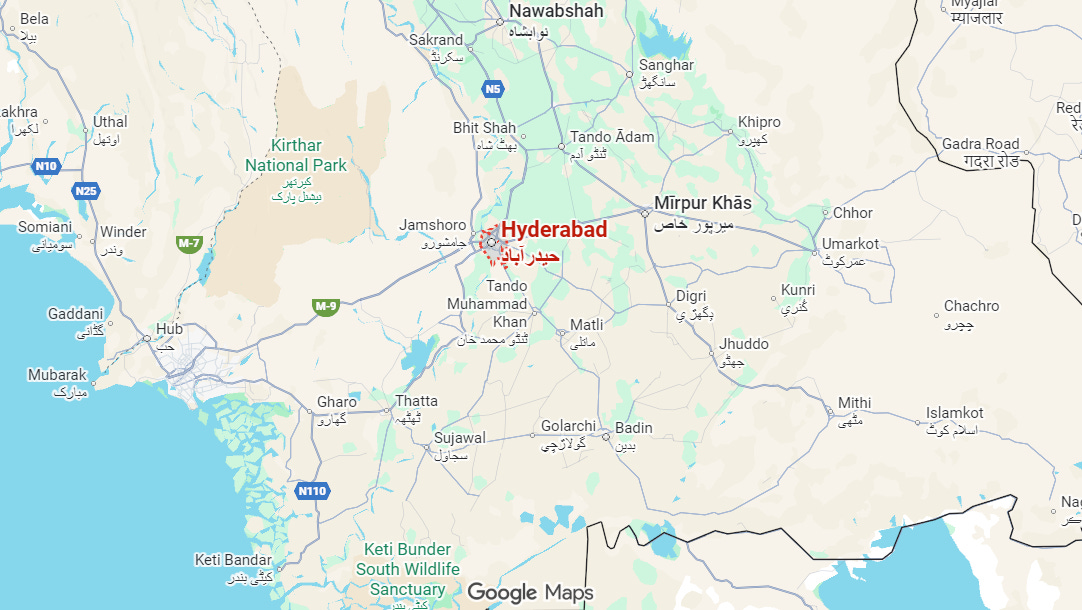
Sindh’s second-largest city, Hyderabad, is as ethnically divided as it is famous for its cakes, bangles, and its refreshing evening breezes for it is in close proximity to the mighty Indus river.
It has three national seats:
- NA-225 Hyderabad-I comprising taluka (subdistrict or tehsil) Qasimabad and Hyderabad Rural (previously NA-221 Hyderabad-III)
- NA-226 Hyderabad-II (Latifabad and one part of Hyderabad City, previously NA-219 Hyderabad-II)
- NA-227 (Hyderabad-III) (City Taluka, one part of Latifabad and one part of Qasimabad, previously NA-220 Hyderabad-I).
The areas of Qasimabad and Hyderabad Rural, which were previously in NA-221, are primarily Sindhi-speaking areas; Latifabad is a primarily Urdu-speaking area, and the City Taluka has a majority Urdu-speaking population, with Sindhis and Pakhtuns residing in pockets.
The city’s national seats, therefore, have historically been divided between the Pakistan Peoples Party-Parliamentarians (PPPP) and the Muttahida Qoumi Movement-Pakistan (MQM-P) since the last three general elections, except for 2002 elections when Sahibzada Abul-Khair Mohammad Zubair of the Muttahida Majlis-e-Amal (MMA) had returned as a successful candidate from then NA-220 Hyderabad-III (Hyderabad City Taluka, now NA-227), defeating MQM’s Aftab Ahmed Shaikh Advocate by a mere 610 votes.
Syed Ameer Ali Shah Jamote of the PPPP has been an MNA from NA-225 Qasimabad (old NA-221) since 2002 elections and has defeated his opponents with huge margins, securing 102,737 votes in 2008 elections, against a weak opposition whose combined vote was 16,822. 2013, however, saw many new faces in the constituency, a decline in vote bank of Jamote, and a marked increase in a collective vote of opposition, with Jamote gaining only 59,821 votes.
The second-biggest chunk of votes went to Dr Rajab Ali Memon of the nationalist Sindh Taraqqi Pasand Party (STPP), who bagged 18,346 votes. The third-biggest gainer was Syed Ahmed Rasheed of the Pakistan Tehreek-i-Insaf (PTI) who gained 14,544 votes. Not to forget 13,026 votes which went to the MQM-P candidate Ghazi Salahuddin.
For an area which was historically a PPPP-stronghold, this was a huge blow, even if it managed to win because all three were new faces in city’s political arena, against a three-time MNA.
The increase in a combined vote of opposition — only 13,905 lesser than the winning candidate — signalled a drop in the popularity of PPPP. This time, none of the contenders of past elections are here; PPPP has given ticket to Syed Hussain Tariq Shah Jamote, son of elder Jamote, PTI to Khawand Bux Ghulam Mohammad (Independent, 4298 votes in 2013), and the Grand Democratic Alliance (GDA) has fielded Naheed Khan Barakzai — an old associate of Benazir Bhutto, who defected away from the PPPP along with her husband, Safdar Abbasi, to form Pakistan Peoples Party-Workers (PPP-W).
Dr Gulzar Jumani of nationalist Qoumi Awami Tehreek (QAT) had initially submitted nomination papers from here but later withdrew in the favour of Barakzai because of QAT’s alliance with the GDA.
It is almost certain that this seat will go to the PPPP.

The NA-226 Latifabad (previously NA-219) was consecutively won by the MQM’s Khalid Maqbool Siddiqui in 2008 and Syed Tayyab Hussain in 2013. This time, Siddiqui is contesting from NA-255 Karachi Central-II and Tayyab is serving as the Mayor of Hyderabad.
Sabir Hussain, former Taluka Nazim of Latifabad and a former MPA from PS-49 Hyderabad-V, part of old NA-219, has been given a party ticket by the MQM-P, and he is contesting against Rashid Ali Khan of Pak Sarzameen Party (PSP) and Jamshed Ali Shaikh (PTI).
Shaikh, an academic himself, comes from a business family, and is a new face on Hyderabad’s political scene, and so is PSP’s Rashid Ali Khan.
Shaikh’s father, Shoukat Ali, had contended against MQM’s Siddiqui in 2013 from Jamaat-i-Islami’s (JI) platform and had secured 13,498 votes, whereas PPPP’s Ali Mohammad Sahito had bagged 14,701 votes.
Local analysts believe that the PTI will put up a good competition because of the division of MQM-P’s vote among PSP and APML, and also because a number of past voters of MQM are expected to abstain because of MQM-L factor.
Apart from that, there’s a perception in Latifabad that MQM-P’s elected representative and its Mayor have not done so much to develop Latifabad in the last five years. The population of Latifabad is mostly educated and comprises middle and upper-middle classes which are PTI’s primary base, and it is to be seen how does this chunk of voters respond on the ballot day, keeping in view the absence of MQM’s formidable electoral machine of the yesteryears.
NA-227 City (previously NA-220) was also consecutively won by the MQM in 2008 and in 2013. Its 2008 winner was Salahuddin and 2013 winner was Syed Waseem Hussain. Hussain has recently defected from the party to join PSP. The party has, therefore, fielded Salahuddin once again, against Sahibzada Abul-Khair Mohammad Zubair of Jamiat Ulema Pakistan (JUP Noorani Group).
Zubair, who took the seat in 2002, had only got 10,990 votes in 2013 elections, whereas the second-biggest chunk of the votes went to PPPP’s Mohammad Sagheer, who got 10,522 votes.
This time, PTI has fielded one named Q. Mohammad Hakam, former Wing Commander in Pakistan Air Force, and PSP has fielded Abdul Rasheed Arain.
Hakam has remained a Union Council (UC) Nazim in Taluka Hyderabad City, which falls in NA-227. He also runs a famous private school in Hyderabad. On the other hand, Arain, a former member of the PML-N, ran for PS-45 (now PS-67) in 2013 elections and got only 681 votes.
The areas that fall in NA-227 are inhabited mostly by Urdu-speaking population, with Sindhis and Pakhtun inhabitants residing here in pockets. The MQM, therefore, has almost always had an appeal here as well.
But Hakam’s position cannot be ignored here because he is not an unknown figure in the city. Zubair, too, may be able to appeal his voter-base because parts of NA-227 have the presence of religious vote bank.
Accurate calls: NA-225
Unclear: NA-226, NA-227

